The Old Model Is Broken
In 1991, the Gulf War demonstrated the decisive advantage of networked warfare. Coalition forces used satellite imagery, GPS-guided munitions, and shared radio networks to defeat a numerically significant Iraqi military in 100 hours of ground combat. The lesson seemed clear: information superiority is a force multiplier.
Three decades later, adversaries have studied that lesson carefully. China’s PLA has built satellite-kill capabilities, electromagnetic warfare systems, and drone swarms specifically designed to blind and isolate American forces before a shot is fired. Russia demonstrated in Ukraine that commercial drone networks, GPS jamming, and adaptive electronic warfare can neutralize systems built on 1990s assumptions about information dominance.
The answer isn’t newer radars or faster missiles. It’s a fundamentally different approach to command and control. That approach is JADC2.
What Is JADC2?
Joint All-Domain Command and Control (JADC2) is the U.S. Department of Defense’s strategic framework for connecting sensors, decision-makers, and weapons systems across all five warfighting domains — land, sea, air, space, and cyber — into a single, coherent operational picture.
The goal is deceptively simple: ensure that any sensor in the joint force can cue any shooter, at any time, across any domain, with the minimum possible latency.
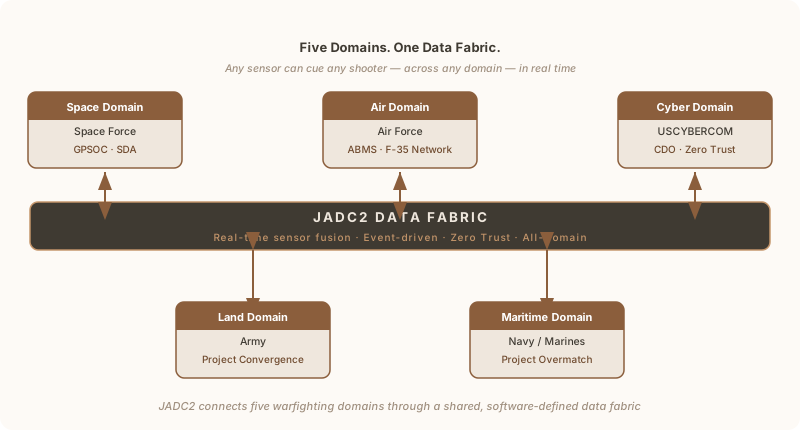
This sounds like a networking problem. It is not. It is a software architecture problem — one that looks remarkably like the distributed systems challenges that cloud engineers solve every day.
Why JADC2 Is a Software Problem
Legacy command and control systems were built service-by-service, each optimized for a specific domain, mission set, and communication standard. The Army uses different data formats than the Air Force. The Navy’s systems don’t natively speak to the Space Force’s sensors. Intelligence products are locked behind classification barriers that prevent real-time sharing with the operators who need them most.
The sensors exist. The shooters exist. The communication links exist. What is missing is the data fabric — a software layer that ingests, normalizes, processes, and distributes information across all domains in real time.
Building that fabric requires every principle in the modern cloud engineer’s toolkit:
- Event-driven architecture — Sensor data is a stream of events, not a database to be queried. Real-time sensor fusion requires publish-subscribe systems capable of processing millions of events per second with sub-second latency
- API-first interoperability — Every system must expose machine-readable interfaces. The Army’s TITAN ground station must be able to query the Air Force’s ABMS the same way a microservice queries an API — without custom integration work for every pairing
- Containerized mission applications — Capabilities must deploy to any edge node — ship, aircraft, armored vehicle, forward operating base — without custom hardware configurations. Kubernetes at the tactical edge (K3s, MicroK8s) is no longer theoretical; it is in production
- Zero Trust security — In a contested, degraded, intermittent communications environment, perimeter security is a fiction. Every transaction must be authenticated, authorized, and encrypted regardless of network position. The DoD has mandated Zero Trust implementation across the enterprise by 2027
- AI/ML inference at the edge — Human decision cycles are too slow for the timelines JADC2 creates. Target recognition, threat prioritization, and course-of-action synthesis must be automated for the decisions that can be automated, freeing human judgment for those that cannot
The Kill Web Replaces the Kill Chain
Traditional military targeting follows a linear kill chain: find a target, fix its location, track it, target a weapon, engage, assess the result. Each step depends on the previous one. The chain is sequential, fragile, and slow — taking hours in the best cases.
JADC2 enables a kill web — a distributed, parallel, resilient mesh of sensors and effectors where any node can substitute for any other. A naval destroyer’s radar identifies an air threat. An Army counter-drone system fires the engagement. An F-35 provides battle damage assessment. No single service owns the engagement. All contribute simultaneously.
This is event-driven architecture applied to warfare. The implications are significant:
Latency is decisive. Compressing sensor-to-shooter timelines from hours to minutes to seconds creates asymmetric advantage. Project Convergence experiments have demonstrated the ability to reduce targeting cycles from 20 minutes to under 20 seconds. An adversary operating on 20-minute cycles cannot compete with a network operating on 20-second ones.
Resilience beats optimization. A kill web degrades gracefully when nodes are destroyed or jammed. The network reroutes around failure. This is the same principle as circuit breakers and chaos engineering in distributed systems — design for partial failure, not just peak performance.
Data quality is everything. Garbage in, garbage out — at the speed of war. Sensor fusion algorithms are only as reliable as the data pipelines feeding them. Data integrity, provenance, and freshness are not engineering niceties in this context. They are operational requirements.
Ukraine Proves the Concept
As we explored in our post on GitOps and modern warfare, the conflict in Ukraine has validated JADC2 concepts at scale — not through DoD programs, but through commercial technology assembled under fire.
Starlink provided resilient, low-latency connectivity that every pre-war NATO analysis assumed would be unavailable in a high-end conflict. It became the backbone of Ukrainian battlefield communications precisely because it had no single point of failure to jam or destroy.
DELTA, Ukraine’s battlefield management system built on commercial cloud infrastructure, aggregated data from drones, infantry units, artillery systems, and partner intelligence sources into a unified operational picture. It is a rudimentary JADC2 implementation, fielded in months, not decades.
Palantir’s Maven Smart System and comparable tools provided AI-enabled analysis that compressed targeting cycles dramatically. High-value target engagements that would previously have required weeks of analytical work were completed in hours.
The lesson is unambiguous: JADC2 is not a future program of record. It is an architectural pattern that can be implemented today with commercial software, open standards, and engineers who understand distributed systems. The DoD’s challenge is not invention — it is procurement, integration, and culture.
The Service Programs
Each branch of the joint force is building its contribution to the shared data fabric:
Air Force — ABMS (Advanced Battle Management System): The cloud-based network that links aircraft, ground systems, and space assets. The F-35 functions not primarily as a fighter but as a flying sensor node, continuously sharing targeting data across the network. ABMS is the Air Force’s answer to the question: what replaces AWACS when the adversary can shoot down E-3s on day one?
Navy — Project Overmatch: Focused on maintaining decision superiority in the maritime and undersea domains, integrating data from submarines, surface combatants, and maritime patrol aircraft in an environment where adversarial A2/AD systems are purpose-built to deny this connectivity.
Army — Project Convergence: An annual experimentation campaign using AI and machine learning to accelerate sensor-to-shooter timelines at the tactical level. Results from recent exercises have been the most tangible demonstrations of JADC2 capability gains in the joint force.
Space Force — Space Domain Awareness: Integrating satellite telemetry, ground-based radar, and intelligence into the JADC2 picture — critical for early warning, GPS resilience, and protecting the space-based assets that every other domain depends on.
The Hard Problems
The concept is straightforward. The execution is not.
1. Interoperability Across Classification Levels
Data crossing classification boundaries requires human review in many legal frameworks. Automating cross-domain data sharing — the core requirement of JADC2 — requires new policy authorities, not just new software. The technology for cross-domain solutions exists. The bureaucratic frameworks for authorizing them at the speed JADC2 requires do not yet.
2. Latency at the Tactical Edge
A Special Forces team in a denied environment or a submarine maintaining emissions control may have intermittent, bandwidth-constrained connectivity with no cloud access. JADC2 systems must function in Contested, Degraded, Intermittent, and Limited (CDIL) communication environments. This demands aggressive edge computing and local AI inference — not cloud dependency — as the baseline design assumption.
3. Adversarial Interference by Design
China and Russia are investing specifically in capabilities designed to disrupt data-centric warfare: anti-satellite weapons, GPS jamming, cyber operations against command networks, and electromagnetic spectrum dominance. JADC2 must treat active adversarial interference as a baseline condition, not an edge case. A system that works in a permissive environment but fails when jammed provides false confidence.
4. Acquisition Timelines vs. Operational Tempo
Software evolves in days. Defense acquisition programs take years. The Agile challenges we’ve examined in the defense context apply here with full force. A JADC2 component built on a 2022 threat model is already partially obsolete. The acquisition system must evolve faster than the adversary can adapt — a problem that is fundamentally organizational, not technical.
The DevSecOps Stack for the Software-Defined Battlefield
Engineers building JADC2-aligned systems are drawing from the same toolkit as commercial cloud architects:
- Platform One — DoD’s Kubernetes-based DevSecOps platform, providing Iron Bank (a hardened container registry with vetted base images) and BigBang (a reference Kubernetes implementation) for consistent, secure software delivery across classified and unclassified environments
- Policy as Code (OPA, Kyverno) — Automated enforcement of security and compliance policies across distributed, disconnected edge nodes — the same approach we detailed in our post on Policy as Code, applied to environments where a manual review process is operationally impossible
- GitOps (Flux, ArgoCD) — Declarative configuration management for edge systems that may be unreachable for extended periods but must converge to a known-good state when connectivity resumes. This is GitOps in its most critical application: not convenience, but survivability
- Apache Kafka / NATS — Event streaming platforms for real-time sensor data distribution, capable of handling the volume and velocity of a sensor-saturated battlespace
- Zero Trust (NIST SP 800-207) — Identity-based access control replacing perimeter security at every layer of the stack
The tools are largely commercial. The challenge is adapting them for environments they were not designed for: physically hostile, electronically contested, legally constrained by the laws of armed conflict, and operating across classification boundaries that commercial systems do not model.
What This Means for Software Engineers
JADC2 is consequential beyond the defense sector for a specific reason: it is forcing the U.S. military to become a serious software organization, and the talent and tooling it requires exist in the commercial sector.
If you work in distributed systems, event-driven architecture, Kubernetes, AI/ML inference, or DevSecOps — the problems being worked on in JADC2 programs are technically interesting and operationally significant in a way that few commercial applications can match.
The organizations building this capability — DoD software factories like Kessel Run, NavalX, and the Army Software Factory; commercial defense technology companies like Anduril, Palantir, and Shield AI; and traditional primes modernizing their software practices — are actively competing for engineers who understand modern software architecture.
The Bottom Line
JADC2 is the most ambitious software integration project in human history. It connects thousands of military systems, across five warfighting domains, in real time, under active adversarial interference, subject to the laws of armed conflict, operating across a dozen classification levels, on every continent and in every ocean.
It will not be solved by a single program, a single contractor, or a single acquisition strategy. It will be solved — to whatever extent it can be — by software engineers applying distributed systems principles, API design patterns, and DevSecOps practices that were developed to handle the scale of global commerce and are now required to handle the demands of great power competition.
The side that fields this capability effectively will hold a decisive operational advantage. The side that remains locked in service-siloed, document-driven, hardware-centric acquisition will face the same disadvantage as any force that fights the last war with the last generation’s tools.
The software-defined battlefield is not a future state. It is the present. The only question is how fast each side can build it.
Are you working on JADC2-related programs or defense technology? What technical and organizational challenges are you running into? Share your experience in the comments.