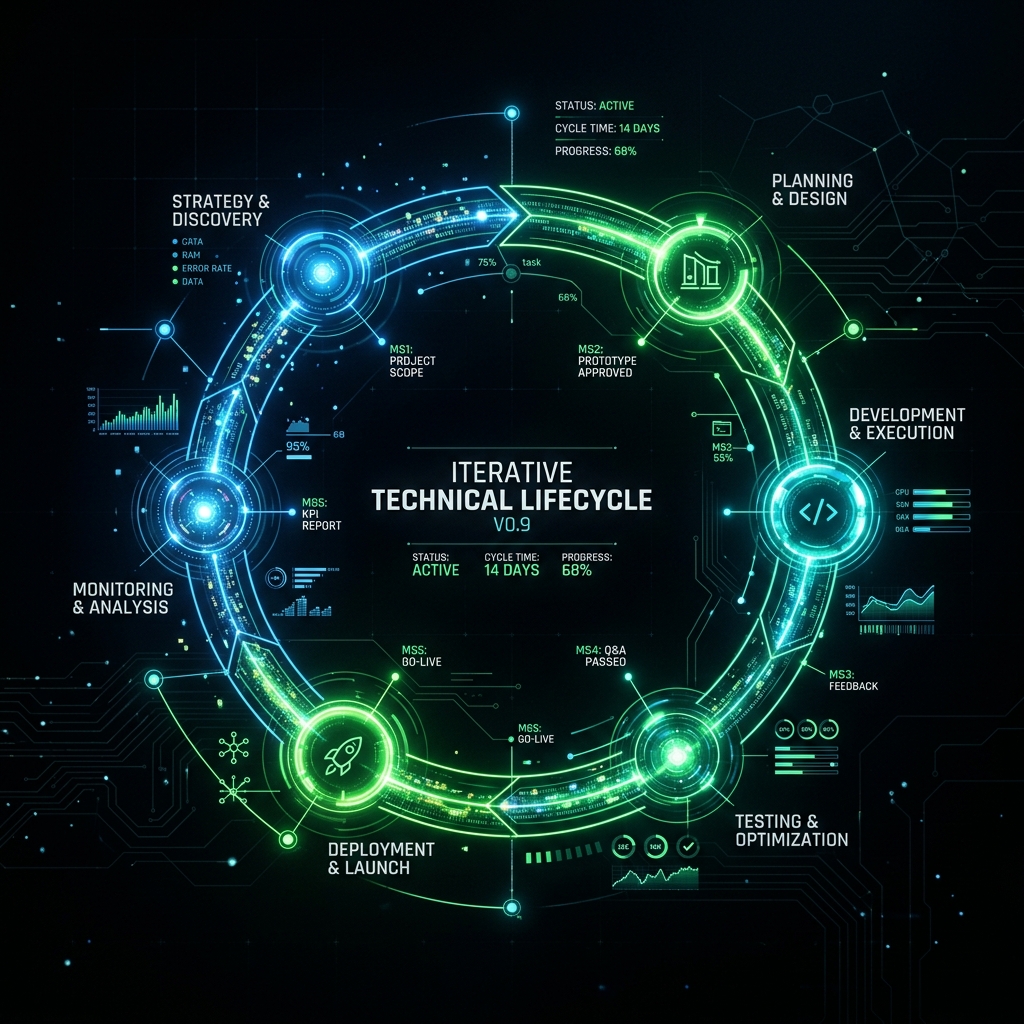
The Big Picture: Standard Agile breaks down in defense environments where security accreditations, compliance audits, and hardware lead times create constraints Silicon Valley never designed for.
Why It Matters
Threats change weekly. Waterfall delivers in 18–36 months. Defense teams must ship secure capability incrementally — without dropping safety or compliance to do it.
The Details
- Continuous ATO (DevSecOps): Automates security validation checks (SAST, container scans) directly within the code pipeline, shifting security from a final bottleneck to continuous verification.
- Hardware-Software Decoupling: Uses digital twins and Hardware Abstraction Layers (HAL) to develop software independently of long-lead physical hardware cycles.
- Automated Documentation: Replaces manual reports with automated API and architecture docs generated directly from source code and Infrastructure-as-Code (IaC).
Go Deeper
The Necessity of Defense Agility
When threats evolve weekly, an 18-36 month waterfall cycle isn’t a process choice — it’s a decision to field obsolete software. Iterative development lets systems adapt to new threats and fold in warfighter feedback in weeks. The defense industry knows this; the argument ended years ago.
However, standard Silicon Valley Agile often fails in defense due to Documentation Gaps, Security Accreditation (ATO) bottlenecks, and Contractual Rigidity. The goal is not to adopt Agile blindly, but to adapt it for the unique constraints of high-stakes mission systems.
The 5 Pillars of Defense Enterprise Agility
To succeed, defense organizations must build a framework that balances speed with enterprise-grade governance:
1. Modular & IDIQ Contracting
Fixed-price contracts lock in requirements before learning happens. Defense leaders should pivot to modular contracting with sequential awards tied to demonstrated capability and IDIQ (Indefinite Delivery/Indefinite Quantity) task orders scoped per release.
2. Continuous ATO (DevSecOps)
Traditional security reviews happen at the end, creating 6-12 month delays. Agile defense requires embedding security engineers into teams and using Continuous ATO approaches where controls are verified incrementally via automated CI/CD pipelines (SAST, DAST, container scanning).
3. Automated & Versioned Documentation
Agile’s emphasis on “working software over documentation” can lead to sustainment nightmares. The solution is Automated Documentation: generating API docs from code and architecture diagrams from IaC, then versioning them in Markdown alongside the source code in Git.
4. Hardware-Software Decoupling
Pure Agile struggles with 3-year hardware cycles. Successful programs use Hardware Abstraction Layers (HALs) and Digital Twins to decouple software development from physical hardware milestones, allowing code to evolve even while components are in production.
5. Architectural Guardrails
Iteration without vision creates technical debt. Organizations must define a modular System Architecture upfront, using Microservices and clearly documented Interoperability Standards to allow team autonomy within defined technical boundaries.
The Bottom Line
You can’t buy defense agility as a certification course — it takes real changes to contracts, culture, and technical practice, and most organizations only get two of the three. The ones that manage all three ship systems that are modular, secure, and responsive to the battlefield. The rest keep building software that’s too rigid to adapt and too slow to matter, with better standup meetings.