The Rise of GitOps
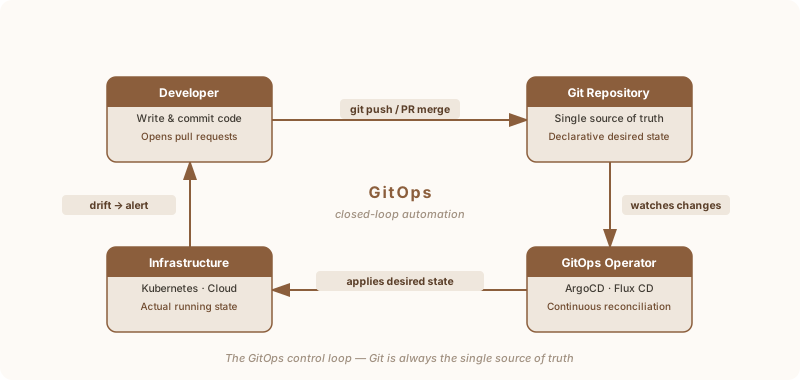
GitOps is an operational framework that applies DevOps best practices—version control, collaboration, compliance, and CI/CD—to infrastructure automation. At its core, GitOps uses Git as the single source of truth for declarative infrastructure and applications, enabling teams to manage complex systems through pull requests, code reviews, and automated reconciliation.
But GitOps is no longer just a convenience for cloud-native applications. In an era defined by AI-driven automation and rapidly evolving battlefield dynamics, GitOps has become a strategic imperative.
Why GitOps Matters Now More Than Ever
1. AI Agents Demand Reproducible Environments
As AI agents become integral to software development, operations, and decision-making, the environments they operate in must be deterministic and reproducible. GitOps provides:
- Immutable infrastructure - Every change is tracked, versioned, and reversible
- Declarative state - AI systems can reason about desired vs. actual state
- Automated drift detection - Systems self-heal when configuration diverges
- Audit trails - Critical for understanding AI decision pathways
When an AI agent deploys code or modifies infrastructure, GitOps ensures that every action is documented, reviewable, and rollback-ready. This is essential for maintaining human oversight of increasingly autonomous systems.
2. Speed and Scale of Modern Operations
Traditional infrastructure management cannot keep pace with modern demands. Whether you’re scaling a global SaaS platform or coordinating distributed sensor networks, GitOps enables:
- Continuous reconciliation - Systems constantly converge toward declared state
- Multi-cluster management - Deploy consistently across hundreds of environments
- Self-service infrastructure - Teams can provision without bottlenecks
- Rapid rollback - Recover from failures in seconds, not hours
GitOps and Modern Warfare: Lessons from Ukraine
The conflict in Ukraine has fundamentally transformed our understanding of modern warfare. The battlefield has become a software-defined environment where the ability to rapidly deploy, iterate, and scale determines success.
The Proliferation of Sensors
Modern battlefields are saturated with sensors—satellite imagery, ground-based radar, acoustic sensors, thermal cameras, and countless IoT devices. Managing this sensor mesh requires:
- Coordinated deployment across distributed nodes
- Rapid firmware and software updates to counter adversary adaptations
- Consistent configuration across thousands of devices
- Real-time state management to ensure operational readiness
GitOps principles allow military systems to treat sensor networks as code—declaratively defining desired states and automatically reconciling deviations.
UAVs: The New Mass
Ukraine has demonstrated that UAVs (Unmanned Aerial Vehicles) represent a new form of mass on the battlefield. Thousands of drones—from commercial quadcopters to sophisticated loitering munitions—require:
- Fleet management at scale - Deploying software updates to thousands of units
- Version control for mission parameters - Tracking changes to targeting algorithms, flight patterns, and communication protocols
- Rapid iteration cycles - Adapting to enemy countermeasures within hours, not months
- Reproducible configurations - Ensuring every drone in a swarm operates identically
The Ukrainian military’s ability to rapidly iterate drone software—sometimes pushing updates overnight to counter new Russian jamming techniques—mirrors the principles of GitOps: continuous deployment, version control, and automated rollout.
Software-Defined Warfare
The modern battlefield is increasingly software-defined:
- Electronic warfare systems require constant updates to jamming and spoofing algorithms
- Targeting systems integrate data from multiple sensors and require synchronized deployments
- Communication networks must adapt to disruption and degradation
- Autonomous systems need coordinated behavior updates across entire fleets
GitOps provides the operational backbone for this software-centric approach to warfare. When a new countermeasure is developed, it can be pushed through a GitOps pipeline—tested, validated, and deployed to thousands of systems simultaneously.
Implementing GitOps for Critical Systems
Core Principles
- Declarative Configuration - Define what the system should look like, not how to get there
- Version Controlled - Every change goes through Git with full history
- Automated Reconciliation - Systems continuously work toward declared state
- Observable - Know the actual state of every system at all times
Tools of the Trade
- Kubernetes + Flux/ArgoCD - For container orchestration and GitOps automation
- Terraform + Atlantis - For infrastructure-as-code with GitOps workflows
- Ansible + AWX - For configuration management with version control
- Crossplane - For managing cloud resources declaratively
Security Considerations
For defense and critical infrastructure applications:
- Signed commits - Ensure only authorized changes enter the pipeline
- Air-gapped deployments - GitOps can work in disconnected environments
- Secrets management - Integrate with HashiCorp Vault or similar tools
- Compliance as code - Encode security policies in the repository
The Convergence of AI and GitOps
AI agents are increasingly capable of:
- Writing and reviewing infrastructure code
- Detecting anomalies and proposing fixes
- Optimizing resource allocation
- Predicting and preventing failures
GitOps provides the guardrails these AI systems need. When an AI agent proposes a change, it goes through the same pull request process as human-authored changes—reviewed, tested, and deployed systematically.
This human-in-the-loop approach, enabled by GitOps, is essential for maintaining control over AI-driven automation while still benefiting from its speed and capability.
The Bottom Line
GitOps has evolved from a deployment convenience to a strategic necessity. Whether you’re managing cloud infrastructure, coordinating AI agents, or deploying software to thousands of drones on a modern battlefield, the principles remain the same: declarative configuration, version control, and automated reconciliation.
The lessons from Ukraine are clear—the side that can iterate fastest, deploy most reliably, and scale most effectively holds a decisive advantage. GitOps is the operational framework that makes this possible.
How is your organization implementing GitOps? Are you prepared for the software-defined future?